.png)
Is Pesto IC-Friendly? Ingredients to Check
Pesto can look like a simple mixture of basil and olive oil, but the ingredient list often tells a more complicated story. Traditional-style green pesto may contain basil, garlic, pine nuts, hard cheese, olive oil and salt. Shop-bought versions can also contain lemon juice, citric acid, cashews, sunflower oil, potato flakes, preservatives, flavourings or other seasonings.
That means pesto is not one single food test. You might tolerate basil and olive oil but react to a strongly garlicky recipe, a concentrated portion, an added acid or a product containing several ingredients you have not tested before.
In simple terms
Pesto is not automatically off limits when you have interstitial cystitis. Read the exact ingredients, start with a small portion and test the product or recipe you actually want to use. Homemade pesto can be useful because it lets you change one ingredient at a time.

Why pesto can be difficult to judge from an IC food list
Most IC food lists name broad categories such as acidic foods, spicy foods, caffeine, artificial sweeteners and chocolate. They do not usually tell you how to assess a multi-ingredient sauce. With pesto, the basil may not be the issue at all. The relevant difference may be lemon juice, citric acid, garlic, a particular cheese, an added spice or the amount used.
There is also no good evidence that pesto as a category must be avoided by everyone with IC/BPS. Dietary responses vary substantially, so the useful question is not simply “Is pesto safe?” but “Which pesto, in what portion, and under what circumstances?”
For more ways to add flavour without relying on one fixed safe-food list, explore 25 IC-Friendly Toppings, Sauces and Seasonings.
The pesto ingredients worth checking
Basil
Fresh basil is the main flavour in green pesto and is not usually listed among the most commonly reported IC trigger categories. That does not make it universally tolerated, but it is often reasonable to test basil separately before assuming the herb itself is the problem.
Garlic
Garlic is not a universal IC trigger. Some people tolerate it well, some find a strongly garlicky sauce uncomfortable and others prefer a garlic-free version. Raw garlic can also taste much stronger than a small amount blended into a meal. Test the form and portion rather than removing it solely because another person reacts to it.
Lemon juice, citric acid and vinegar
Acidic foods and citrus drinks are commonly reported symptom triggers, so lemon juice or added citric acid may be relevant for some people. Not every pesto contains them. Compare the label with a version made without lemon, citric acid or vinegar before deciding that basil pesto itself is the problem.
Cheese
Traditional pesto often uses Parmesan, Grana Padano or Pecorino. Dairy is not a universal IC trigger, but the type and amount of cheese may matter to an individual person. Aged cheeses may also be relevant to people who notice histamine-related or allergy-type patterns, although that does not mean everyone with IC needs a dairy-free pesto.
Nuts and seeds
Classic pesto uses pine nuts, while many commercial products use cashews because they are less expensive. Other recipes use walnuts, almonds, sunflower seeds or pumpkin seeds. These ingredients are not automatic IC triggers, but the exact nut or seed matters if you have an allergy, digestive sensitivity or a personal symptom pattern.
Oil, salt and added seasonings

Olive oil is common in homemade pesto, but shop-bought versions may contain sunflower, rapeseed or blended oils. Some products are also very salty or contain pepper, chilli, flavourings, yeast extract or preservatives. Do not blame every additive automatically; save the label and compare the product with a simpler version.
Shop-bought pesto: what to look for on the label
Read the entire ingredient list rather than relying on the front of the jar. “Basil pesto” can still contain lemon juice, acidity regulators, garlic purée, cashews, aged cheese, pepper or preservatives. “Free from” pesto may remove dairy or nuts but add other ingredients to replace texture and flavour.
When you are comparing products, look for the shortest useful ingredient list—not because every additive is harmful, but because fewer variables make your response easier to interpret. Photograph the label so you can compare it later if you react differently to another brand.
Green pesto and red pesto are different tests
Red pesto commonly contains tomato or sun-dried tomato and may also include chilli, vinegar, peppers or added acids. Tomatoes and high-acid tomato products are frequently reported as IC trigger suspects, so a reaction to red pesto does not prove that green basil pesto will affect you in the same way.
Treat basil pesto, red pesto, rocket pesto and other herb sauces as separate foods. The colour and name may be similar, but the ingredient profile can be completely different.
Homemade pesto gives you more control
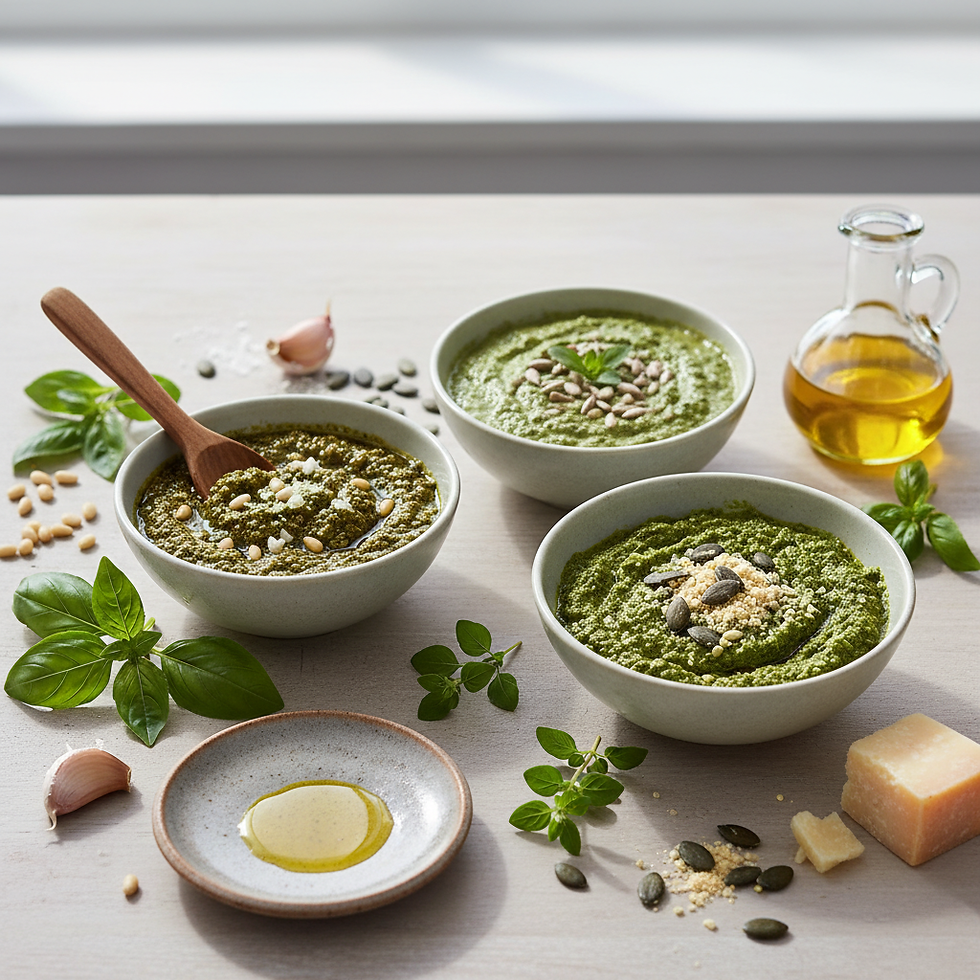
A simple homemade version can start with fresh basil and olive oil, then add only ingredients you already tolerate. Cheese, nuts, seeds, garlic and lemon can each be introduced or adjusted separately. This makes homemade pesto especially useful when a commercial product caused an unclear reaction.
Possible variations include garlic-free pesto, a milder-cheese version, dairy-free pesto using a tolerated nutritional or savoury substitute, nut-free pesto made with seeds, or a lemon-free version loosened with extra olive oil or a little water. These are customisation ideas, not universally safe recipes.
How to test pesto without confusing the result
Choose a day when symptoms are reasonably close to your usual baseline. Add a small measured amount—around half to one teaspoon—to a familiar meal such as plain pasta, rice, potato, chicken or a tolerated vegetable. Do not test it for the first time in a restaurant meal with an unfamiliar sauce, drink and dessert.
Record the exact pesto, ingredients, portion and your symptoms before eating. Track what happens during the first two hours, later that day and the following morning. Also note sleep, stress, constipation, cycle changes, hydration and whether a flare may already have been developing.
If the small amount is comfortable, test a realistic portion on another stable day. If the result is unclear, compare the same meal with a simpler homemade pesto that removes one suspect ingredient. Repeat uncertain results before labelling all pesto as a trigger.
For a repeatable challenge process, follow How to Test a Food When You Have IC and record the exact pesto, amount, meal and symptom timing.
Simple ways to use a pesto you tolerate
A small amount of pesto can add flavour to pasta, rice bowls, chicken, fish, roasted potatoes, sandwiches, wraps, eggs or cooked vegetables. Mixing a spoonful with ricotta, yoghurt, cream cheese or extra olive oil can spread the flavour through a meal while reducing the concentration per mouthful—provided those additions suit you.
Portion matters. A light coating may be comfortable when a heavily dressed bowl is not. Record the amount that works rather than forcing pesto into a simple safe-or-unsafe category.

When pesto may not be the right food to test
Do not deliberately challenge a pesto containing a nut, milk ingredient or another food that has caused hives, swelling, wheezing, breathing difficulty or a suspected allergic reaction. Food-allergy testing is different from tracking IC symptoms and may require medical supervision.
Wait until another time if you are in a severe or unexplained flare, think you may have a urinary infection or have new red-flag symptoms. Seek medical assessment for fever, chills, flank pain, vomiting, visible blood in the urine, inability to pass urine or feeling seriously unwell.
The answer: pesto can be personalised
Pesto does not need to be treated as a permanent IC blacklist food. Some people will find that a particular product or ingredient reliably worsens symptoms. Others may tolerate a homemade lemon-free version, a smaller portion or a different combination of cheese, nuts and garlic.
Test the exact pesto you want to eat, keep the rest of the meal familiar and use your results to build a diet that is broad enough to nourish you and flexible enough to enjoy.
Free IC Ally tools to personalise your next step
Download the free 10-page IC Food Starter Pack → It includes common trigger suspects, better-tolerated starting foods, simple meal ideas, flare-day guidance and a food-and-symptom tracker.
If food seems to be only one part of your symptoms, use the IC Phenotype Identification Aid to explore possible pelvic-floor, bladder-lining/chemical-irritation, histamine/reactivity, hormone-linked, nervous-system/stress and infection-aftereffect patterns.
Frequently asked questions
Is pesto safe for IC?
It can be tolerated by some people and trigger symptoms for others. The exact recipe, product and portion matter more than the general name.
Is garlic-free pesto better for IC?
It is useful when garlic is a genuine personal suspect, but it is not automatically better for everyone. Other ingredients such as lemon, cheese or additives may still matter.
Can I make pesto without lemon?
Yes. Lemon is optional. Use basil, olive oil and tolerated additions, then adjust the texture with more oil or a small amount of water.
Is vegan pesto more bladder-friendly?
Not automatically. Removing cheese may help someone who does not tolerate that ingredient, but vegan products can contain acids, flavourings, nuts, seeds or other personal suspects.
How much pesto should I test first?
Begin with a small measured amount, such as half to one teaspoon, alongside a familiar meal. Test a realistic portion separately if the first amount is comfortable.
Sources and further reading
National Institute of Diabetes and Digestive and Kidney Diseases: Eating, Diet & Nutrition for Interstitial Cystitis. Last reviewed July 2024.
Almutairi S (2024): Dietary Influence on Bladder Pain Syndrome: A Systematic Review. Cureus, 16(9), e69437.
This article is for general education and does not replace diagnosis, treatment or individual medical, allergy or dietetic advice. Food responses vary. Seek medical assessment for new, severe, unusual or changing urinary symptoms. Do not test a food at home if it has caused swelling, breathing difficulty or anaphylaxis, and ask a registered dietitian for support if your diet is becoming very restricted.


Comments