.png)
IC Elimination Diet: How to Find Your Triggers Without Over-Restricting
Updated: Aug 11
Quick answer: how do you do an IC elimination diet?
An IC elimination diet is a short, structured test—not a permanent list of forbidden foods. You temporarily remove a small group of likely bladder triggers, keep the rest of your diet steady and nutritionally adequate, then reintroduce foods one at a time while tracking pain, pressure, burning, urgency and frequency.
The goal is to find the smallest number of foods or drinks that repeatedly affect you, then return everything else to your diet.
A 2026 systematic review found that individualised elimination diets may improve IC/BPS symptoms, but the evidence remains limited: only four studies with 147 participants were included. There is no scientifically proven universal “IC diet” that everyone should follow.
Free printable support: Download the 10-page IC Food Starter Pack for trigger categories, simple meal ideas, food-testing steps and a food-and-symptom tracker.
What an IC elimination diet should—and should not—do
A useful elimination diet is temporary, individualised and followed by reintroduction. It should help answer a focused question: which foods or drinks repeatedly change my symptoms?
It should not become a permanent “safe list”, a detox, a food-allergy test or a reason to remove every food mentioned online.
Keep it small enough to follow consistently.
Keep supplements, hydration and other major variables stable.
Maintain adequate energy, protein, fibre, vitamins and minerals.
Remember that infection, hormones, constipation, pelvic-floor tension, sex, stress, sleep and activity can also affect symptoms.
Return tolerated foods promptly.
Does food really affect interstitial cystitis?
Food does not affect everyone with IC/BPS in the same way, but dietary sensitivity is common enough to investigate. The US National Institute of Diabetes and Digestive and Kidney Diseases lists citrus, coffee, tea, fizzy drinks, alcohol, tomato, spicy foods, artificial sweeteners, chocolate and MSG among commonly reported triggers, and recommends a food diary to identify personal patterns.
In an earlier questionnaire study, 90% of 104 participants with IC reported that at least one food, drink or supplement worsened symptoms. More recent cohort research also found food sensitivity was more common in people with IC/BPS than in healthy controls—but it was not universal.
The evidence supports personal testing, not lifelong restriction of every commonly reported trigger.
Before you begin: make sure this is the right time
Do not begin a food challenge when symptoms are rapidly changing or when you may have an infection. Delay the experiment and seek medical advice for new or unusual symptoms, fever, chills, flank pain, vomiting, difficulty passing urine, pregnancy, visible blood that has not been assessed, or feeling significantly unwell.
Get individual guidance from a registered dietitian or clinician before broad restriction if you are underweight, losing weight, pregnant or breastfeeding; have diabetes, kidney disease, significant gastrointestinal disease or multiple allergies; have a history of an eating disorder; are removing a whole food group; or are planning the diet for a child or teenager.
Do not deliberately reintroduce a food that has caused breathing difficulty, throat swelling, collapse or another possible allergic reaction. Food-allergy challenges require medical supervision.
Step 1: record a normal baseline first
Before removing anything, track your usual food and symptoms for about five to seven days. Record meals, drinks, approximate portions, pain, pressure, burning, urgency, bathroom visits, bowel movements, cycle stage, sleep, stress, sex, exercise, urine-test results, medicines and supplements.
Do not aim for a perfect diary. A short, consistent record is more useful than a complicated tracker you abandon.

Step 2: choose the smallest useful elimination
Option A: targeted elimination
Use this when you already suspect one to three items—for example coffee, fizzy drinks and tomato sauce. Remove only those items while keeping the rest of your food, hydration and routine stable. This is easier to follow and gives clearer information.
Option B: common-trigger elimination
Use this when symptoms feel food-related but you have no clear suspects. Temporarily remove the most consistently reported categories:
Coffee, energy drinks and caffeinated tea
Alcohol
Citrus fruit and juice
Tomato and tomato-based sauces
Chilli and very spicy foods
Fizzy drinks
Chocolate and cocoa
Artificial sweeteners
MSG and strongly flavoured seasoning packets
Vinegar-heavy foods, sharp pickles and acidic dressings
Cranberry products and sharp fruit juices
You do not automatically need to remove dairy, gluten, soy, nuts, eggs, all fruit, all seasoning, all leftovers or every food on an online IC chart. Test these only when your own history gives you a reason or a dietitian recommends it.
Step 3: build an adequate baseline diet
Your baseline should be simple enough to interpret but varied enough to nourish you.
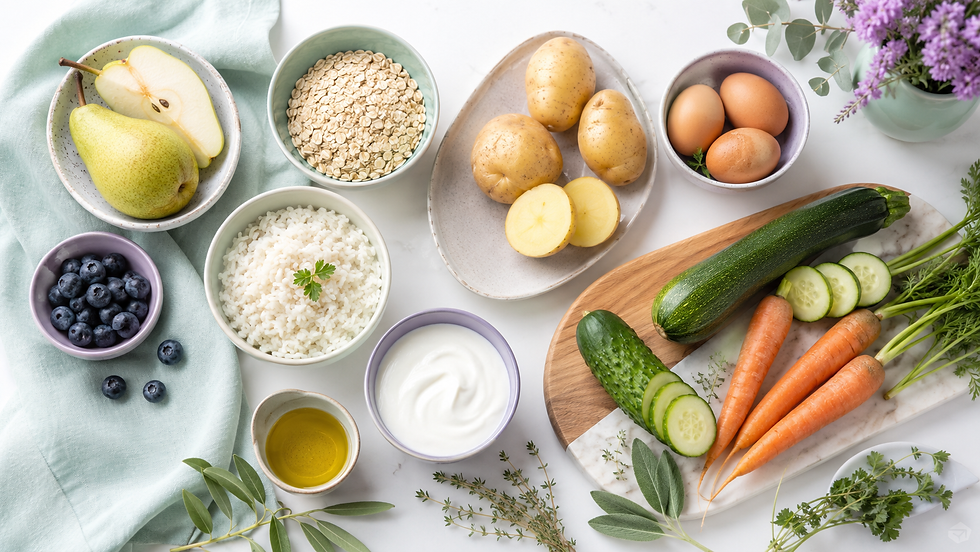
Use foods you already believe you tolerate.
Protein: eggs, chicken, turkey, fish, tofu, lean meat or tolerated dairy
Starches: rice, oats, potatoes, pasta, bread, quinoa or couscous
Vegetables: carrots, green beans, broccoli, courgette, cucumber, leafy vegetables or squash
Fruit: pears, blueberries, melon or another fruit you already tolerate
Fats and flavour: olive oil, butter, mild herbs, cream cheese, tahini or mild cheese if tolerated
A simple day might include porridge with pear, eggs with toast, chicken and rice with cucumber and herbs, a baked potato with cottage cheese, fish with potatoes and green beans, plus familiar snacks. These are examples, not guaranteed “safe foods”.

Step 4: keep the elimination phase short
There is no single proven duration for an IC elimination diet. For a targeted trial, many people can judge whether symptoms are becoming steadier within one to three weeks.
Continue long enough to obtain a reasonably stable baseline, but do not remain indefinitely on a highly restricted diet waiting for perfect symptom relief. Keep supplements, hydration, portions and meal timing reasonably consistent, and maintain adequate calories and protein.
If there is no meaningful improvement after a well-followed trial, food may not be the main driver—or the suspected foods may be wrong. Reintroduce what you removed rather than making the diet progressively smaller.
Step 5: reintroduce one food or ingredient at a time
Reintroduction is the part that provides the answer. Without it, you only know that several changes happened together.
Record your symptoms before the test.
Try a small amount in the morning or at lunchtime.
If there is no clear reaction, try a normal realistic portion later that day or the next day.
Keep the rest of your meals familiar.
Record symptoms for the rest of the day and the following morning.
If the result is unclear, return to baseline and repeat on another stable day.
Do not introduce another uncertain food until symptoms are back near baseline.
Test single ingredients before complicated products. Plain tomato is easier to interpret than pizza containing tomato, aged cheese, chilli, processed meat and several additives.
How should you judge a possible food reaction?
Track pain, pressure, burning and urgency scores; daytime and night-time bathroom visits; time from eating to symptoms; portion size; duration; and other factors present that day.
Clear likely trigger
The same food causes a noticeable, repeatable increase in symptoms on more than one occasion, with other factors reasonably stable.
Dose-dependent trigger
A small amount is comfortable but a larger portion causes symptoms. Portion size or frequency may matter more than complete avoidance.
Context-dependent or uncertain trigger
The food appears to matter only during menstruation, an existing flare, poor sleep, constipation, stress or after several other triggers—or too many factors changed to interpret the test. Return to baseline and repeat later.
No meaningful effect
The food does not repeatedly worsen symptoms. Return it to your normal diet. One reaction is a clue, not proof.
Which foods should you reintroduce first?
Foods you miss and strongly suspect are tolerated
Foods that restore an important source of protein, calcium, fibre or energy
Flexible ingredients that make meals easier
Common triggers you genuinely want to test
Mixed dishes and restaurant foods after individual ingredients are clearer
Do not spend weeks testing several similar vegetables while major food groups remain excluded. Aim to broaden the diet efficiently.
What if a food causes symptoms?
Stop the challenge and return to your familiar baseline until symptoms settle. Record the food, amount, timing and reaction. Later, you may repeat the challenge, try a smaller portion, test a different preparation, use it less often, or revisit it during a calmer period.
Common mistakes that make the results unreliable
Removing too many foods at once
Changing supplements during the test
Testing during an unstable flare
Challenging mixed restaurant meals or packaged products
Never reintroducing tolerated foods
Treating every symptom change as food-related
What if the IC elimination diet does not help?
That is useful information. It may mean food is not a major driver, your strongest trigger was not included, or symptoms are too variable to interpret. Do not respond by cutting more and more foods without a clear plan.
Consider other contributors such as pelvic-floor tension, hormone-linked flares, nervous-system sensitisation, infection after-effects, constipation, allergy-type symptoms or another bladder condition. The free IC phenotype identification aid can help organise possible patterns, but it is not a diagnostic test.
Your simple IC elimination-diet plan
Track your usual diet and symptoms for five to seven days.
Choose a targeted or common-trigger elimination.
Keep meals adequate, familiar and consistent.
Trial the change for about one to three weeks rather than indefinitely.
Reintroduce one food or ingredient at a time.
Test a realistic portion and watch through the next morning.
Repeat unclear reactions.
Return tolerated foods promptly.
Seek dietetic help if the diet becomes broad, prolonged or nutritionally difficult.
Frequently asked questions
How long should an IC elimination diet last?
There is no universal evidence-based duration. A targeted elimination is usually kept short, often around one to three weeks, until symptoms are stable enough to begin reintroduction. Broad restrictions should not continue indefinitely without professional guidance.
What foods should I eliminate first for IC?
Begin with your strongest personal suspects. When there are no clear suspects, commonly reported categories include caffeine, alcohol, citrus, tomato, spicy foods, fizzy drinks, chocolate, artificial sweeteners and MSG. You do not need to remove every food on an IC chart.
How quickly can a food trigger an IC flare?
Timing varies. Some people notice symptoms within minutes or hours, while others notice changes later that day or the next morning. Record timing and repeat the challenge before deciding a food is a reliable trigger.
Should I eliminate gluten or dairy for IC?
Not automatically. Gluten and dairy are not universal IC triggers. Remove them only when your own history suggests a link, you have another relevant condition, or a clinician or dietitian recommends a structured trial.
How do I reintroduce foods after an IC elimination diet?
Test one food or ingredient at a time while the rest of your diet stays familiar. Begin with a small amount, progress to a realistic portion, track symptoms through the next morning and repeat unclear tests on another stable day.
What if almost every food seems to trigger me?
Speak with a clinician and registered dietitian rather than continuing to restrict. A severe flare, pelvic-floor tension, constipation, hormones, infection, nervous-system sensitisation or another condition can make eating appear responsible when the pattern is more complex.
Can an IC elimination diet cure interstitial cystitis?
No. It is a symptom-management and trigger-identification tool. It may reduce food-related flares for some people, but it does not diagnose or cure IC/BPS.
References and further reading
Alahmed et al. (2026): Interstitial Cystitis and Dietary Interventions—A Systematic Review
Almutairi (2024): Dietary Influence on Bladder Pain Syndrome—A Systematic Review
Shorter et al. (2007): Effect of Comestibles on Symptoms of Interstitial Cystitis
Shorter et al. (2014): Validation of the Shorter-Moldwin Food Sensitivity Questionnaire
Friedlander, Shorter and Moldwin (2012): Diet and Its Role in IC/BPS
This article is educational and does not diagnose or treat illness. An elimination diet should complement appropriate medical care. Seek personalised advice if symptoms are new or severe, if you are losing weight, or if restriction is affecting your nutrition or relationship with food.


Comments