.png)
IC Food List PDF and Printable Diet Chart

Updated: Aug 11
Searching for an IC food list often brings up long charts divided into “safe foods” and “foods to avoid”. These can feel reassuring at first, but they can also create a new problem: the chart starts to replace your own experience.
Food and drink triggers vary between people with interstitial cystitis or bladder pain syndrome. A list is therefore most useful when it helps you organise personal evidence—not when it becomes a permanent rulebook that removes dozens of foods you may actually tolerate.
The IC Ally printable uses three practical categories: usually comfortable for me, need to test, and possible personal trigger. It also includes a food-test record, symptom diary, meal builder and reliable-food list so you can turn a generic starting point into something genuinely personal.

Download the IC Ally food list and printable diet chart
The downloadable pack is an eight-page A4 PDF designed for printing or completing digitally. It includes:
A personal food chart arranged by food group
A one-food testing and reintroduction record
A three-day food, drink and symptom diary
A personal meal builder and shopping list
A reliable-food and flare-day reference page
Download the free 8-page IC Ally Food List & Printable Diet Chart Print it or complete it digitally to build your own reliable-food list, test uncertain foods and keep track of meals without turning a generic chart into permanent rules.
Why this is not another universal safe-food chart
The NIDDK advises that a food diary can help people work out which foods and drinks are linked to their own symptom flares. It also suggests considering support from a registered dietitian when creating an individual eating plan.
A 2026 systematic review found that dietary interventions may help some people with IC/BPS, but the available randomised evidence was still too limited for strong universal recommendations. That makes personal testing and avoiding unnecessary restriction especially important.
Use three columns instead of “safe” and “unsafe”
A two-column list forces every food into a yes-or-no decision. Real life is often less clear, so the printable uses three categories.
Usually comfortable for me
Place foods, products and meal combinations here when you have eaten them more than once without a convincing symptom pattern. Record the exact form: plain chicken may be comfortable while a marinated or heavily seasoned product is not.
Need to test or uncertain
This is the most important column. Use it for foods you have never tested, foods eaten during a complicated flare, or foods linked to symptoms only once. Uncertain does not mean unsafe.
Possible personal trigger
Reserve this column for reasonably repeatable patterns. Note the portion, preparation, brand and timing rather than writing only a broad label such as “dairy” or “fruit”.

How to complete your printable food chart
Start with foods you already eat. Do not begin by copying every item from an online trigger list.
Record exact products and preparation. Ingredients in bread, yoghurt, sauces, stock and snack foods can vary considerably.
Include the portion. A small amount may be comfortable while a large serving is not, or the apparent link may reflect meal size rather than one ingredient.
Record symptom timing. Some changes may be noticed quickly, while others are noticed later that day or the following morning.
Consider non-food factors. Stress, poor sleep, menstruation, sex, pelvic-floor tension, constipation, illness, supplements and activity can overlap with food timing.
Return foods that pass. The aim is a broader reliable diet, not a growing list of permanent restrictions.
Use the meal builder to keep the diet practical
A list of individual foods does not always answer the question, “What can I actually eat?” The meal-builder page helps combine a familiar starch, protein, fruit or vegetable, and a tolerated fat, topping or sauce.
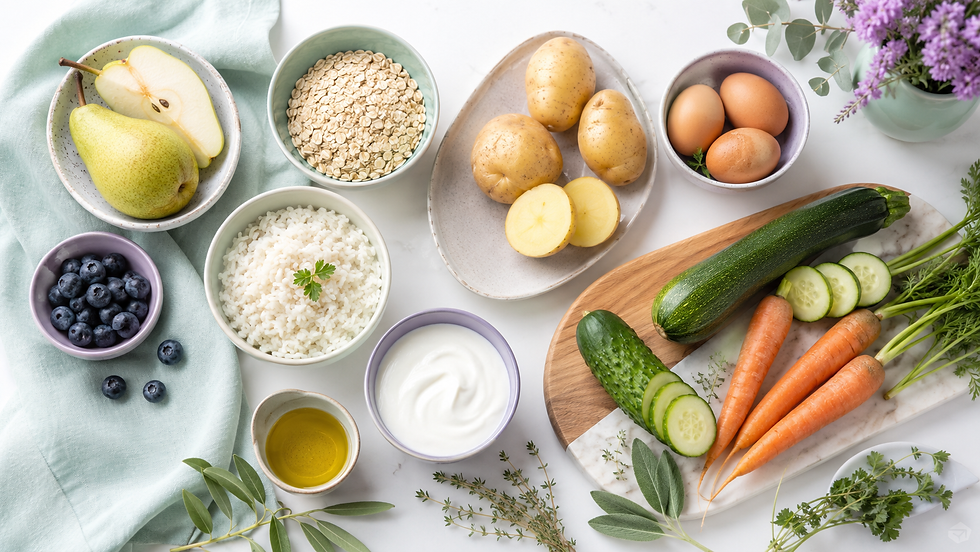
Examples might include oats with milk and pear; rice with chicken, courgette and herb oil; or a baked potato with cottage cheese and cucumber. These are examples to customise—not guaranteed safe combinations.

How to test one food or product
Choose a day when symptoms are relatively close to your usual baseline and infection is not suspected. Keep the rest of your food, drinks, supplements and routine reasonably familiar.
Record your symptoms before the test, try a small but meaningful portion, and note changes at around two hours, six hours and the following morning. One flare after one meal is a clue, not proof. Repeat an unclear test on another stable day before labelling the food as a long-term trigger.

Starting-point food groups to personalise
The printable provides space for starches and grains, protein foods, vegetables, fruit, dairy or alternatives, fats and toppings, drinks, snacks and packaged foods. The small examples are prompts only. Add foods from your usual cuisine, family meals, cultural foods and practical work or travel options.
Do not remove gluten, dairy, legumes, fruit or any other broad category automatically. Remove or replace a category only when your own history, another medical condition or professional advice gives you a reason.
Signs your food list is becoming too restrictive
The comfortable-food column keeps getting shorter even though tests are unclear
You are losing weight unintentionally or struggling to eat enough
Meals, shopping or eating away from home are causing significant fear or distress
You have removed several major food groups without a structured reintroduction plan
You have allergies, diabetes, kidney disease, pregnancy or another condition that affects food choices
A registered dietitian can help protect nutrition while you investigate symptoms. Psychological support may also be appropriate when fear of food is becoming a major part of daily life.
Free IC Ally tools to personalise your food list
Download the free IC Ally Food Starter Pack for a gentle meal planner, food-and-symptom diary and one-food testing worksheet.
If food or drinks explain only some of your flares, use IC Ally’s free Phenotype Identification Aid to explore possible Pelvic Floor, Bladder Lining/Chemical Irritation, Histamine & Reactivity, Hormone-Linked, Nervous System/Stress and Infection-Aftereffect patterns. These are practical pattern families, not diagnoses, and more than one may apply.
For a broader starting point, see the Ultimate IC Food List and the gentle IC elimination diet guide.
Frequently asked questions
Is there one official IC food list?
No. Food and drink triggers vary, so a generic list is best used to identify possible tests rather than permanent rules.
Should I print the chart in colour?
Colour makes the three categories easier to scan, but the PDF remains usable in greyscale. You can also complete it digitally using a PDF annotation app.
Can I use the chart during a flare?
Use your reliable-food page to choose familiar meals during a flare. A flare is generally not the best time to test several new foods or products.
How often should I update it?
Update it whenever a test becomes clearer or a product recipe changes. A brief monthly review can prevent old assumptions from becoming permanent restrictions.
Sources and further reading
This article and printable are for general education and tracking. They do not diagnose IC/BPS, identify infection or replace individual medical or dietetic advice. Seek medical assessment for new, severe or unusual urinary symptoms, fever, flank pain, vomiting, visible blood, urinary retention, pregnancy, or symptoms that feel different from your usual pattern.


Comments